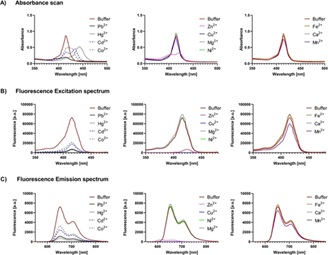
The invention proposes fluorescent probes for quantifying free metal ions, in particular free copper ions (Cu²⁺), for analysis in biological and chemical samples. The specific interaction between the fluorophore and the metal ion causes measurable changes in fluorescence, which allow quantitative determination of the metal ion concentration.
Biomedical diagnostics: Determination of copper and other metal ion concentrations in body fluids or cell samples. Environmental analysis: Detection of metal ions in water or soil samples. Pharmaceutical research: Investigation of metal-dependent enzyme activities. Materials science: Control of metal ions in industrial processes or catalysts.
The real-time monitoring of biologically significant metal ions such as Cu²⁺ and Zn²⁺ is a valuable tool for the diagnosis and study of diseases including Alzheimer’s disease and age related macular degeneration.
However, to date, only a limited number of fluorescent probes are available that respond quantitatively and selectively to changes in the concentrations of such metal ions under biologically relevant conditions. The present invention addresses this need by providing easily measurable, fluorescence-based sensors that respond precisely and dynamically to metal ions and are particularly suitable for use in biological samples.
The fluorescent probe consists of an organic fluorophore that is coupled via a covalent bond to one or more metal-binding functional groups. These groups can be, for example, phosphonic acid and arsonic acid groups bound to carbon or nitrogen atoms. When metal ions are added, the electron configuration in the fluorophore changes, resulting in a measurable change in fluorescence. The method allows both the detection of individual metal ions and the differentiation of different ion types based on specific fluorescence signatures.
Ina Krüger
Technology Transfer Manager
+49 (0)30 314-75916
ina.krueger@tu-berlin.de
Technology validated in relevant environment
pending: EP, US
Technische Universität Berlin


The Center for Intellectual Property (ZfgE) at the TU Berlin is the central point of contact for all topics relating to intellectual property law and intellectual property.
We patent and market the inventions of the TU Berlin, and we also teach and research technical and intellectual property law.
This makes us the central contact for inventors of the TU Berlin, for cooperation partners from industry and science as well as for interested scientists and experts from the fields of technology and law.
Zentrum für geistiges Eigentum
Technische Universität Berlin
Straße des 17. Juni 135
10623 Berlin