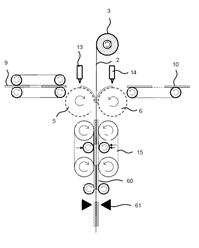
The invention relates to a method and an apparatus for the continuous production of electrode-separator assemblies for battery cells. Electrodes are picked up, transported, redirected and transferred with precise positioning onto a separator material fed in the form of a strip by means of at least one vacuum roller. Different surface areas of the roller independently generate a vacuum to hold the electrode and positive pressure to selectively detach and press it against the separator. An adhesive bond is formed between the electrode and the separator, which can be achieved even without the application of heat. The method is designed for high throughput, short process times and precise positioning of the electrodes.
Manufacture of electrode-separator composite structures for various battery cell designs, in particular for stacked and Z-folded cell architectures, as well as for the large-scale production of high-capacity battery cells for various battery systems in stationary or mobile applications.
In the manufacture of high-capacitance cells with stacked or Z-folded ESVs, the stacking process is the rate-limiting stage and thus restricts throughput in battery cell production. Whilst it is possible to increase throughput by raising the speed or introducing parallelisation in existing ESV manufacturing processes, the necessary stoppages in the process flow result in a throughput limitation that is virtually insurmountable. The search for alternative, high-throughput approaches to stacking is therefore a major driver in industry and academia.
Using the proposed technology, it is possible to manufacture the electrode-separator assembly in large quantities with high precision and in a time-saving manner. The process is characterised by the use of a cold, fast-setting (<1 s) bonding process for joining during ESV production, rather than a heat-induced bonding process, as is currently standard, such as that used in lamination. The cold application of the adhesive via variably adjustable dispensers also allows for flexible application formats, enabling the production of various discrete and tape-shaped ESVs without the need for lengthy changeover times. An innovative mounting concept for the rollers required for the process also allows adaptation to other geometries without prolonged shutdowns of the entire production line.
Ina Krüger
Technology Transfer Manager
+49 (0)30 314-75916
ina.krueger@tu-berlin.de
System prototype demonstration in operational environment
pending: CA, US
approved: DE
Technische Universität Berlin


The Center for Intellectual Property (ZfgE) at the TU Berlin is the central point of contact for all topics relating to intellectual property law and intellectual property.
We patent and market the inventions of the TU Berlin, and we also teach and research technical and intellectual property law.
This makes us the central contact for inventors of the TU Berlin, for cooperation partners from industry and science as well as for interested scientists and experts from the fields of technology and law.
Zentrum für geistiges Eigentum
Technische Universität Berlin
Straße des 17. Juni 135
10623 Berlin