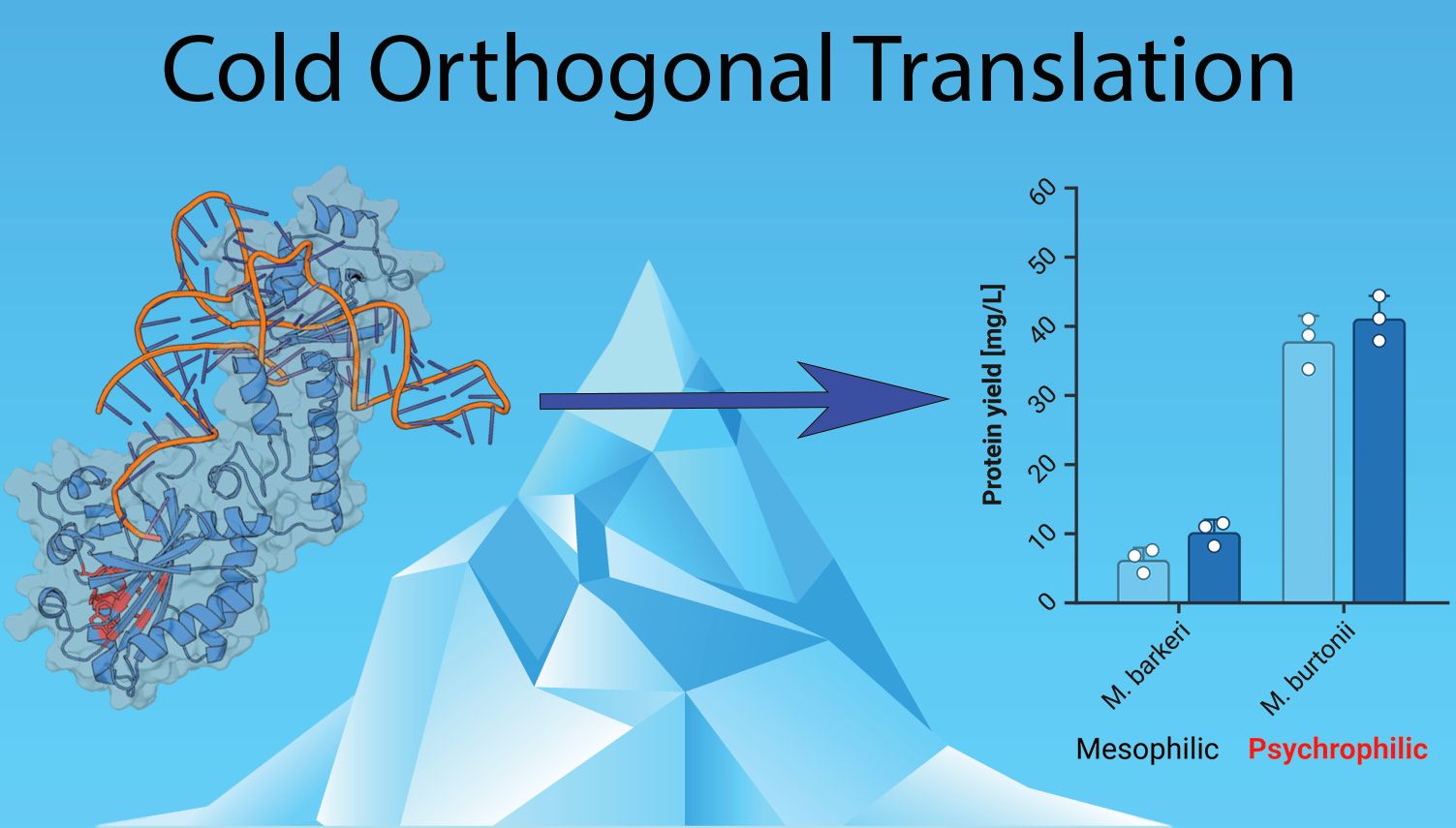
The invention provides a powerful platform technology for equipping proteins with new functions in a more efficient, controlled and cost-effective manner – a key enabler for applications in biotechnology, pharmaceuticals and the life sciences.
• Production of recombinant proteins with defined chemical functions, e.g. photoreactive, click chemical or conjugatable groups • Protein-drug conjugates (PDCs) and protein-protein conjugates • Site-specific labelling of proteins for biophysical and cell biological analyses • Photo-crosslinking studies to investigate protein-protein interactions (e.g. using photo-leucine) • Platform technology for synthetic biology, protein engineering and functional proteomics
The expansion of the genetic code using orthogonal aminoacyl-tRNA synthetase/tRNA pairs is an established tool in synthetic biology. However, known PylRS-based systems suffer from low catalytic efficiency, especially in the multisite incorporation of ncAAs. This limits both yield and industrial applicability.
The present invention addresses this limitation by developing a highly active, psychrophilic PylRS variant from M. burtonii with targeted mutations in the catalytic centre. This makes it possible to specifically equip recombinant proteins with additional chemical functions that are not accessible or only very inefficiently accessible using conventional biotechnological methods. During protein production in the cell, the greatly improved enzyme ensures that so-called non-canonical amino acids (ncAAs) are reliably and efficiently incorporated into proteins. These ncAAs carry special chemical groups, e.g. for coupling reactions, labelling or light-active functions.
The efficiency of the technology has already been validated in E. coli and in human HEK293T cells.
Ina Krüger
Technology Transfer Manager
+49 (0)30 314-75916
ina.krueger@tu-berlin.de
Technology validated in relevant environment
pending: EP
Technische Universität Berlin


The Center for Intellectual Property (ZfgE) at the TU Berlin is the central point of contact for all topics relating to intellectual property law and intellectual property.
We patent and market the inventions of the TU Berlin, and we also teach and research technical and intellectual property law.
This makes us the central contact for inventors of the TU Berlin, for cooperation partners from industry and science as well as for interested scientists and experts from the fields of technology and law.
Zentrum für geistiges Eigentum
Technische Universität Berlin
Straße des 17. Juni 135
10623 Berlin