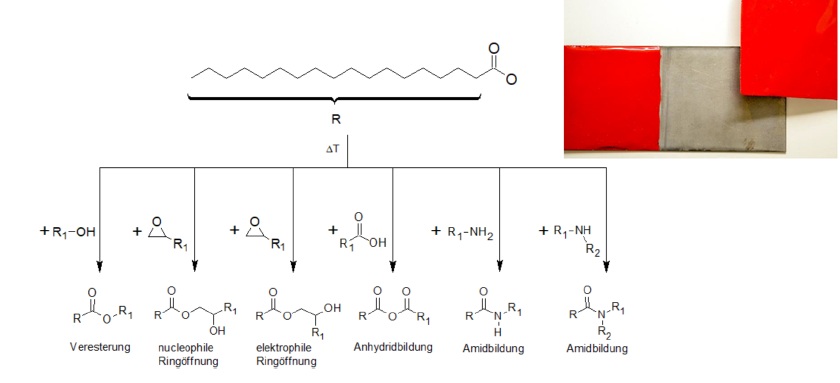
The invention describes a process for recycling powder coating waste in which the adhesion-promoting functional groups of the powder coatings are chemically inactivated by adding a surfactant. This allows powder coating waste to be thermally processed without sticking to metal surfaces, e.g. by extrusion or injection moulding, and used as a high-quality raw material in recycling processes or other applications.
• Extrusion of recycled powder coatings for the production of plastic strands and granulates. • Injection moulding using modified powder coating waste as filler or base material. • 3D printing process with increased print resolution. • Additive manufacturing of improved powder coating-based structures through the addition of long-chain fatty alcohols. • Combination of powder coating waste with thermoplastics such as PP or PE for the production of cost-effective filled composite materials
Around 500,000 tonnes of powder coating waste are generated worldwide every year. Due to its adhesive properties and chemical reactivity, this waste is difficult to recycle and must be disposed of at great expense. In particular, its strong adhesion to metal surfaces during thermal processes prevents economical further processing. Previous recycling methods are either only suitable for certain powder coating systems or lead to caking and equipment wear. The invention closes this gap by chemically inactivating the adhesion-promoting groups.
The process involves the provision of solvent-free powder coating waste, e.g. from thermosetting systems such as epoxy, polyester or hybrid powder coatings. These are mixed with an anionic surfactant as reactants, such as saturated fatty acids or PEGs.
The functional groups are inactivated by chemical reactions such as esterification, ring opening, amide formation or acid hydrolysis. Subsequent heating of the reactant-powder coating mixture (≥ 60 °C) activates the reactions and ensures freedom from adhesion. Pilot tests in extrusion, injection moulding and 3D printing were successfully carried out using industrial parameters, and functionality in various polymer matrices (e.g. PE, PP) was demonstrated.
Ina Krüger
Technology Transfer Manager
+49 (0)30 314-75916
ina.krueger@tu-berlin.de
Technology demonstrated in relevant environment
pending: AU
approved: CN, DE, FR, GB, US
Technische Universität Berlin


The Center for Intellectual Property (ZfgE) at the TU Berlin is the central point of contact for all topics relating to intellectual property law and intellectual property.
We patent and market the inventions of the TU Berlin, and we also teach and research technical and intellectual property law.
This makes us the central contact for inventors of the TU Berlin, for cooperation partners from industry and science as well as for interested scientists and experts from the fields of technology and law.
Zentrum für geistiges Eigentum
Technische Universität Berlin
Straße des 17. Juni 135
10623 Berlin