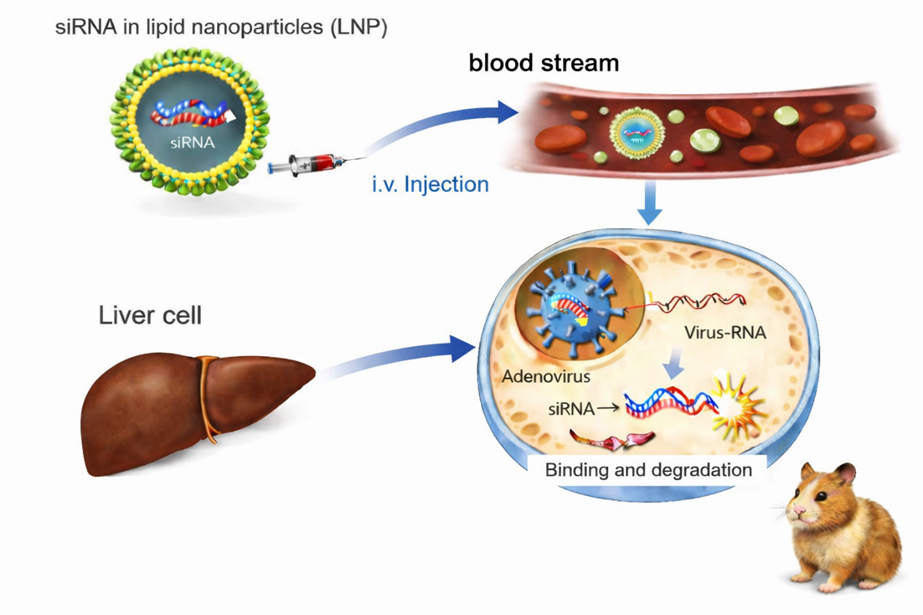
The patent application describes a chemically modified siRNA technology for the targeted inhibition of human adenoviruses. Through increased stability, reduced immune activation and encapsulation in lipid nanoparticles, the invention enables effective systemic antiviral therapy, which has been validated preclinically in cell and animal models. It addresses a previously unmet medical need, as there is currently no approved therapy for adenovirus infections.
• Therapeutic treatment of human adenovirus infections, in particular hepatic hAdV infections in immunosuppressed patients, e.g. following organ transplantation or chemotherapy • Potential treatment of adenoviral respiratory infections, conjunctivitis, gastroenteritis
Human adenoviruses (HAdV) usually cause self-limiting infections, but can trigger life-threatening systemic infections and, in particular, liver inflammation in immunocompromised patients. To date, there is no approved antiviral therapy for the treatment of HAdV infections. RNA interference (RNAi) is a promising approach, but has so far failed due to the lack of stability of RNAi-inducing small interfering RNAs (siRNAs) and the lack of transfer systems with which the siRNAs can be transferred into the corresponding virus-infected target cells. The present invention specifically addresses these limitations by using highly efficient anti-adenoviral siRNAs with chemically modified nucleotides and a lipid nanoparticle (LNP) transfer system that enables the efficient transfer of siRNA into liver cells.
The siRNA directed against various HAdV serotypes contains several modifications of the nucleotides used. These include 2′-O-methyl modifications as well as phosphorothioate linkages, which were introduced at defined positions within the siRNA. These modifications increase the stability of the siRNA by inhibiting its degradation by endonucleases.
For encapsulation of the siRNAs, lipid nanoparticles composed of a specifically formulated lipid mixture are employed, which facilitate preferential uptake of the particles by hepatocytes.
Inhibition of adenoviral replication and therapeutic efficacy were demonstrated both in human cell lines and in immunosuppressed Syrian hamsters infected with HAdV. This resulted in a significant reduction in viral load in the liver, attenuation of virus-induced liver damage, and a decrease in HAdV titers in blood and spleen.
Ina Krüger
Technology Transfer Manager
+49 (0)30 314-75916
ina.krueger@tu-berlin.de
Technology validated in relevant environment
pending: EP, US
Technische Universität Berlin


The Center for Intellectual Property (ZfgE) at the TU Berlin is the central point of contact for all topics relating to intellectual property law and intellectual property.
We patent and market the inventions of the TU Berlin, and we also teach and research technical and intellectual property law.
This makes us the central contact for inventors of the TU Berlin, for cooperation partners from industry and science as well as for interested scientists and experts from the fields of technology and law.
Zentrum für geistiges Eigentum
Technische Universität Berlin
Straße des 17. Juni 135
10623 Berlin