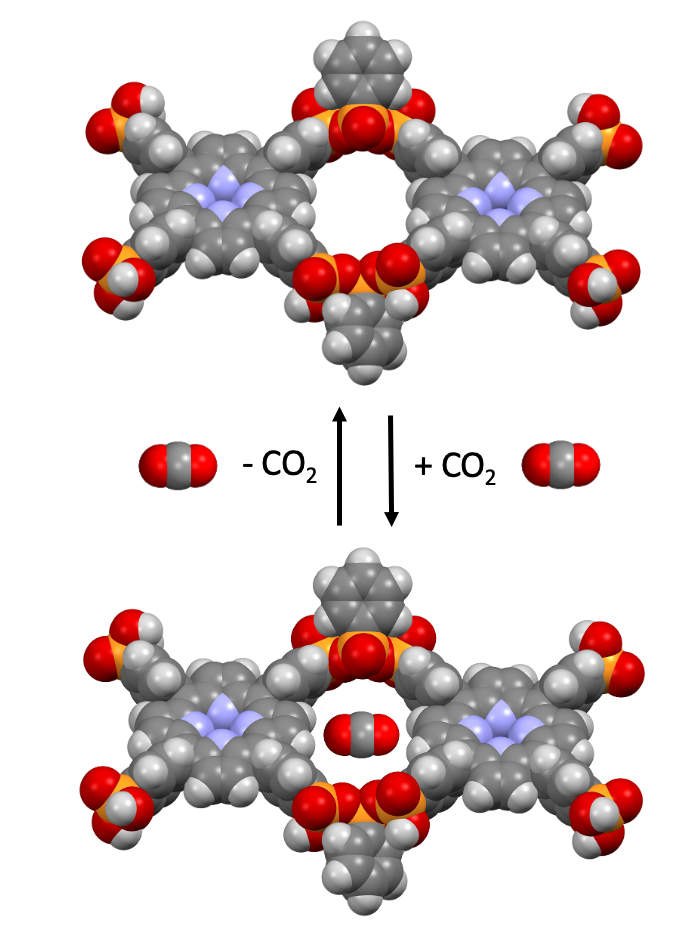
The invention discloses a new class of hydrogen-bonded organic frameworks (HOFs) built from organic linkers containing a hydroxyl group and a tetrahedral central atom. These HOFs uniquely combine semiconductive and proton-conductive properties with adjustable porosity and high thermal stability. They do not require metals, are environmentally friendly, and are suitable for advanced energy and electronic applications.
CO2 capture, Proton exchange membrane fuel cells, Electrode material in electrochemical double-layer capacitors and supercapacitors Photoactive layers in solar cells and other semiconductor applications (e.g. flexible electronics, printed electronics, printed conductors, thin-film transistors) Components in active and passive electronic devices and as printing materials for electronic components
Conventional porous framework materials — MOFs, COFs, and HOFs — have diverse applications in carbon capture, battery electrodes, supercapacitors, and solar panels, but their industrialization faces bottlenecks such as poor water stability and insulating nature. Herein, we report the scalable and sustainable synthesis of stable phosphate-HOFs and COFs. The HOFs and COFs described here are simply organic linkers cross-linked by hydrogen bonds and P-O-P bondes respectively, enabling sustainable synthesis, high chemical stability and recyclability, and new material properties beyond those of conventional MOFs, COFs, and HOFs.
The central component is an organic linker containing at least one hydroxyl group and a tetrahedrally coordinated central atom (e.g. R-PO3H2). Porosity can be tuned to surface areas above 3000 m2/g. Band gaps typically range from 1.4–1.7 eV, depending on linker design, and conductivities can range between 10-10 to 102 S/cm. Synthesis can be achieved using versatile linkers with V-, L-, T-, Y-, X-shaped geometries. Syntheses of HOFs proceed by crystallizing organic linkers in polar or non-polar solvents, while COFs are obtained via single step condensation of linkers without solvents. HOF thin films form easily and can be converted into more stable COF phases upon heating.
see also Nature Communications 15, 7862 (2024) https://doi.org/10.1038/s41467-024-51950-1
Ina Krüger
Technology Transfer Manager
+49 (0)30 314-75916
ina.krueger@tu-berlin.de
Technology demonstrated in relevant environment
pending: EP, US
approved: CN
Technische Universität Berlin


The Center for Intellectual Property (ZfgE) at the TU Berlin is the central point of contact for all topics relating to intellectual property law and intellectual property.
We patent and market the inventions of the TU Berlin, and we also teach and research technical and intellectual property law.
This makes us the central contact for inventors of the TU Berlin, for cooperation partners from industry and science as well as for interested scientists and experts from the fields of technology and law.
Zentrum für geistiges Eigentum
Technische Universität Berlin
Straße des 17. Juni 135
10623 Berlin