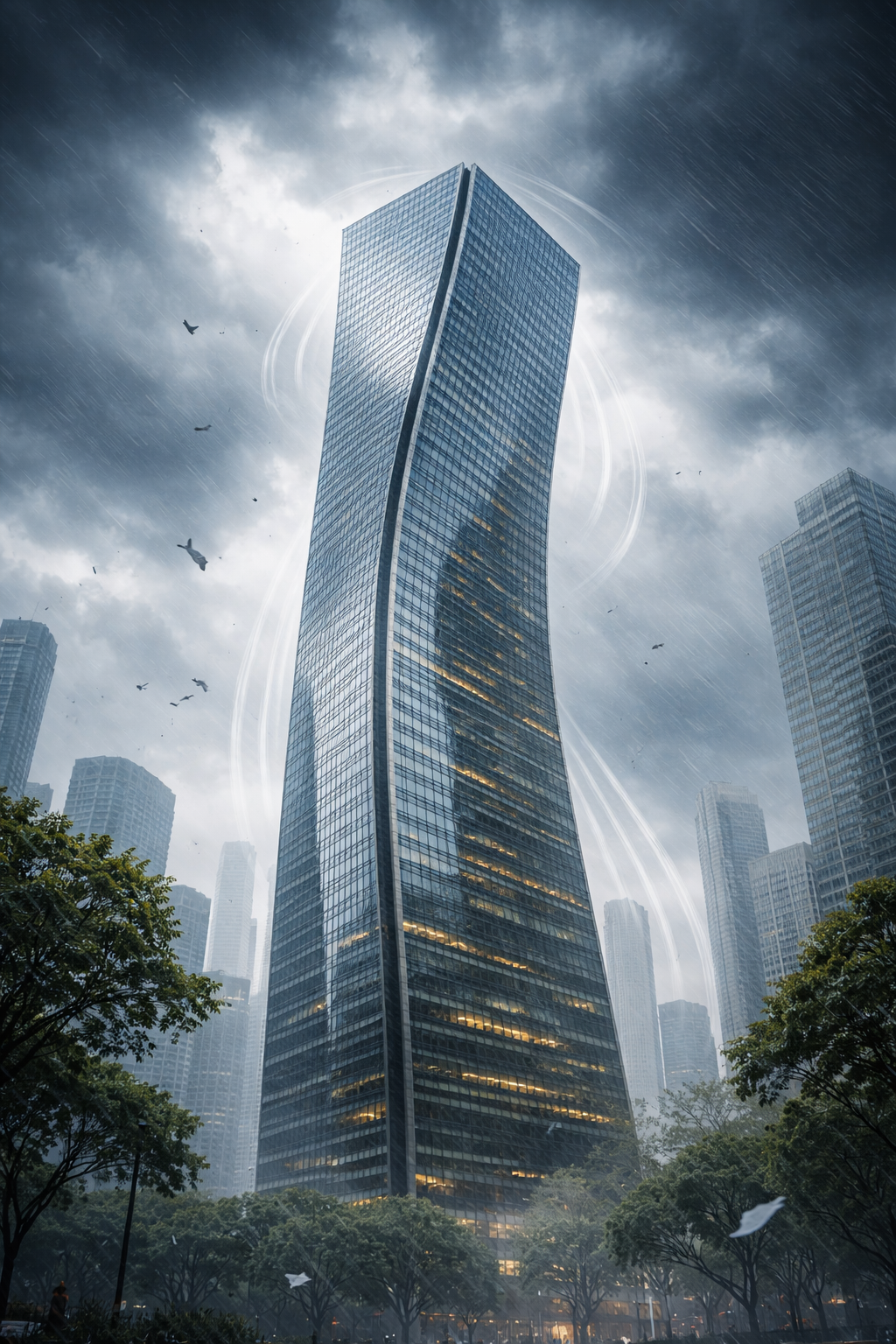
The invention describes an arrangement and a method for damping structural vibrations, in which a damping device is positioned between a wall element and a movable cladding element. The relative movement between the two elements is specifically utilised to dissipate vibrational energy.
The invention is particularly suitable for slender high-rise buildings, which are susceptible to wind-induced vibrations due to their low inherent stiffness. Furthermore, it can be used in existing buildings (retrofit), as existing facade elements can be utilised as damping mass. Further applications arise in structures subject to dynamic loads caused by earthquakes, as well as in sustainable building concepts with a focus on resource efficiency.
As urbanisation increases, buildings are becoming ever slender and taller, making them increasingly vulnerable to dynamic loads such as wind or earthquakes. Climate change is also expected to result in ever-higher wind loads in the future. Existing solutions (e.g. dampers, pendulum masses) often require significant installation space or complex structures and have limitations in terms of efficiency and integration. Increased material usage, additional weight and lost floor space lead to economic disadvantages. At the same time, active systems can result in additional energy consumption.
The invention is based on the arrangement of a movable cladding element, preferably a facade element, relative to a wall element with a damping device integrated between the two elements. The movement takes place parallel to the wall surface. A spring system couples the two elements and is tuned to the natural frequency of the structure.
The damping device (passive, semi-active or active) dissipates the relative movement and may also be designed as an electrical damper. With an integrated generator, the kinetic energy can be converted into electrical energy.
The distributed arrangement of several such facade elements across the height of the building results in a system that functionally corresponds to a distributed multi-mass damper, but without the need for additional masses
Ina Krüger
Technology Transfer Manager
+49 (0)30 314-75916
ina.krueger@tu-berlin.de
Technology validated in lab
pending: DE, EP, US
Technische Universität Berlin, BTU Cottbus-Senftenberg


The Center for Intellectual Property (ZfgE) at the TU Berlin is the central point of contact for all topics relating to intellectual property law and intellectual property.
We patent and market the inventions of the TU Berlin, and we also teach and research technical and intellectual property law.
This makes us the central contact for inventors of the TU Berlin, for cooperation partners from industry and science as well as for interested scientists and experts from the fields of technology and law.
Zentrum für geistiges Eigentum
Technische Universität Berlin
Straße des 17. Juni 135
10623 Berlin