The patent describes a novel processor architecture wich combines the easy programmability of RISC architectures with CGRA-like high energy efficiency. This makes the approach very well suited for embedded, edge and IoT systems where both energy efficiency and programmability are critical.
The technology is particularly suitable for embedded, edge and IoT systems where both energy efficiency and programmability are critical. Example applications include battery-powered sensor nodes and signal processing applications.
Conventional microcontrollers and CPU-based Systems-on-Chips (SoCs) are highly programmable but limited in energy efficiency. One reason for this is the continuous energy overhead of the instruction stream. Reconfigurable arrays (FPGAs, CGRAs) can process data with a higher energy efficiency but are difficult to program. The concept described combines the easy programmability of RISC architectures with CGRA-like high energy efficiency.
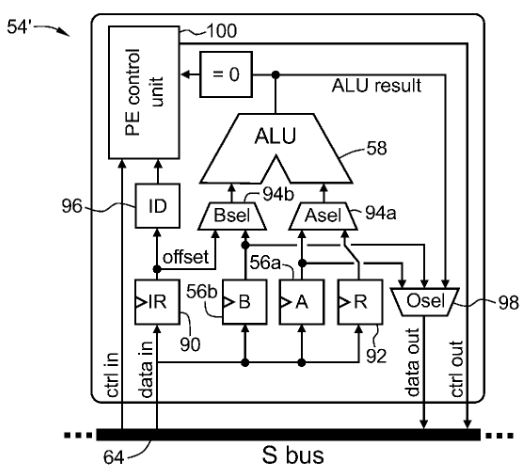
The architecture consists of a matrix of processing elements (PEs), each of which decodes and executes instructions. Each PE has an instruction register, ALUs for arithmetic and logical processing, several memory registers (A, B, R), a control unit for local decision logic and branches. The S-bus forms the data paths between parts of the array, while the M-bus is responsible for communication with external units, memory and a Fragment Instance Manager (FIM). The system operates on a fragment basis, with program sections being loaded into the processing elements. The FIM manages the execution, storage and recovery of these fragments in order to dynamically adapt computing loads to hardware resources. Its instruction set, based on 32-bit words, allows for simple decoding, minimal operand types and supports simultaneous data and control flow coordination.
Ina Krüger
Technology Transfer Manager
+49 (0)30 314-75916
ina.krueger@tu-berlin.de
Technology validated in lab
pending: EP, US
Technische Universität Berlin


The Center for Intellectual Property (ZfgE) at the TU Berlin is the central point of contact for all topics relating to intellectual property law and intellectual property.
We patent and market the inventions of the TU Berlin, and we also teach and research technical and intellectual property law.
This makes us the central contact for inventors of the TU Berlin, for cooperation partners from industry and science as well as for interested scientists and experts from the fields of technology and law.
Zentrum für geistiges Eigentum
Technische Universität Berlin
Straße des 17. Juni 135
10623 Berlin